| | | | | | | | APRIL 2026 Welcome to the April 2026 edition of Disability Law News. This issue tracks several new developments with Social Security Administration (SSA) disability policy, technology, and operations. We cover recent concerns related to SSA’s reported sharing of appointment information with ICE and other data-sharing issues, the launch of a new team at SSA focused on SSI, the delay of SSA’s efforts to centralize its calendar and workflow, and SSA’s announcement regarding DDS handling of continuing disability reviews (CDRs). We also cover SSA’s latest “waterfall” chart and several SSA announcements, including adding “good cause” statements to ARS, SSA’s decision to join TEFCA, and the issuance of a new Emergency Message about expedited processing. Also included is OPM’s final rule on civil service and what it may mean for federal employment protections. Finally, we summarize two recent reports describing worsening barriers to benefits, and we provide an updated Bulletin Board. | | | |  | | | While the Social Security Administration (SSA) continues to a major shift toward nationalized service delivery, the agency has again postponed implementing some of the technology tied to that shift. SSA has paused the nationwide rollout of its National Appointment Scheduling Calendar (NASC) and the related National Workload Management (NWLM) system. According to multiple news outlets, an internal email to SSA staff dated March 31, 2026 announced that an April 13 launch was being “pause[d] until further notice.” This followed an earlier postponement from early March. For now, the rollout is limited to Tennessee and Nevada only, per two Emergency Messages (EMs), EM-26017 and EM-26018, issued April 18, 2026. NASC is designed to replace locally managed appointment calendars in SSA field offices and to allow appointments to be scheduled and reassigned on a national basis, including through public self-scheduling for certain initial claims. NWLM is intended to complement that system by distributing work across offices nationally rather than by geographic catchment area. Work would be assigned to the next available technician based on their skillset. Federal News Network reports that SSA leadership cited operational concerns and the need for further testing, with the agency now considering a pilot-based approach in two states rather than immediate nationwide deployment. SSA also cited the need to ensure customer confidence. Union representatives have raised concerns about the loss of local discretion, whether state-specific rules – such as those involving a state supplemental payment (SSP) as is provided in New York – will be applied correctly, and the impact on claimants who rely on established relationships with local field offices. The calendar and workload tools are part of a broader, ongoing effort to centralize customer service and workload distribution at SSA. In a separate decision last fall, SSA had instructed staff to schedule all initial claims by phone only and “zero-out” in-person visits; it later rescinded that directive. | | | Telephone service has already been centralized, with calls to local offices now being increasingly re-routed to other offices that are sometimes, but not always, in the same area. Under this model, a claimant may no longer interact primarily with their nearest SSA office, even when seeking in-person services. The agency’s public-facing tools also reflect this change. SSA’s online Field Office Locator no longer returns only a single assigned local field office for a given zip code, but instead will list several nearby offices, reinforcing the diminished role of a single home office for a claimant. Essential to this shift is the centralizing of SSA’s document management. Currently, documents faxed to published field office fax lines are routed directly into the agency’s WorkTrack system, where they become visible to field office staff. Previously, visibility was limited to select staff in the assigned field office. According to SSA, all field personnel, not just managers, can now view WorkTrack items nationwide through an SSN-based search once they are profiled. Unprofiled or unassigned faxes are visible only within the receiving office. Inc. magazine reports that SSA leadership has framed the upcoming transition as a way to improve efficiency and appointment availability amid severe staffing shortages. Others at SSA have described the changes as intended to “smooth over” staffing shortages, but it remains unclear how a reorganization can compensate for the loss of over 7,400 employees, about 13% of staff, in only a year. SSA has also “reshuffled” staff by reassigning over 2,000 employees who normally process benefits to answer phone lines; some employees complained they received insufficient training. Other questions also remain about how national calendaring would function in practice, for example how appointments will be assigned to staff with the right technical expertise, and how appointments will be prioritized and allotted sufficient time. As these changes continue to unfold, Disability Law News will monitor developments, particularly for their impact on equitable access to SSA programs and services. | | | | | | | |  | | | Recent reporting has raised new alarm about the Social Security Administration’s (SSA) handling of sensitive claimant information, particularly where agency data may be used for immigration enforcement or other non-programmatic purposes. In February, WIRED reported that SSA employees at some field offices were instructed to share information about upcoming in‑person appointments with Immigration and Customs Enforcement (ICE) if requested by ICE agents. According to the reporting, this information could include appointment dates and times for individuals scheduled to appear at SSA offices. The reporting relied on accounts from SSA employees and former officials, and described the instructions as having been communicated verbally rather than through public guidance or written policy. Although SSA has not publicly acknowledged such a policy, the implications are significant. Advocates have long emphasized that SSA field offices (FOs) function as access points for essential benefits and services, including for U.S. citizen children and lawfully present noncitizens who may be accompanied by family members with more precarious immigration status. The prospect that appointment information could be used to facilitate ICE presence at SSA locations raises concerns about whether individuals may be deterred from accessing benefits or complying with agency requirements out of fear of enforcement activity. Notably, the reported instructions, if accurate, would conflict with SSA’s existing policies, which are clear that FO staff are not independently authorized to disclose information to the Department of Homeland Security (DHS) or ICE. Under the Privacy Act and SSA’s disclosure regulations at 20 C.F.R. Part 401, any such request must be made in writing and routed to the Office of Privacy and Disclosure within SSA’s Office of General Counsel, not handled locally. See POMS GN 00313.001, 03313.095, 03312.080. Disclosure is permitted only in response to a valid, documented law-enforcement request that meets strict criteria and that is processed at administrative levels higher than the FO. The report is occurring in a broader landscape of expanded inter‑agency sharing that continues to draw increasing scrutiny. As discussed in the July 2025, October 2025, and January 2026 issues of Disability Law News, SSA has been engaged in expanded information-sharing arrangements and the use of Systems of Records Notices (SORNs) to facilitate cross-agency sharing with systems including the Systematic Alien Verification for Entitlements (SAVE) database – a system used by agencies to verify immigration status that now permits bulk queries of citizenship data for hundreds of millions of SSN holders – prompting concerns about secondary uses of program data for purposes such as immigration enforcement or voter eligibility verification. This use of SAVE is the subject of ongoing litigation. | | | Privacy concerns are further deepened by new details regarding the breach last year of SSA systems by affiliates of the Department of Government Efficiency (DOGE). Last month, the Washington Post reported that a new anonymous whistleblower has claimed that an ex-DOGE member told several co-workers that he had in his personal possession SSA’s entire Numident and Master Death File databases and “at least one thumb drive” for use at his new company, and that he retained “‘God-level’ security access to the agency’s systems.” A separate whistleblower complaint filed last year by SSA’s former chief data officer alleged that DOGE members had improperly uploaded sensitive data onto a digital cloud. SSA’s inspector general is investigating the new whistleblower complaint and alerted four Congressional committees of the disclosure. Minority members of the House Oversight Committee and other Democrats, including Senator Ron Wyden, have called for briefings. Despite this revelation, as well as an admission by SSA to the lower court in January about the improper sharing of data with a political advocacy group, the Fourth Circuit issued an opinion on April 10, 2026 vacating the district court decision in American Federation of State, County and Municipal Employees, AFL-CIO v. Social Security Administration, 778 F. Supp.3d 685 (D.Md. Apr. 17, 2025) granting preliminary injunction, and limiting DOGE access. The Circuit decision was based on the record before the district court at the time it issued the preliminary injunction, and deferred to the Supreme Court’s prior stay of the injunction pending a disposition of the appeal. In a footnote, the opinion stated that although it considered the new disclosures to be "alarming” and “rais[ing] serious questions about the [SSA’s] earlier conduct before the district court,” it was for the district court to consider the new facts. More details about the case are in the April 2025 issue of this newsletter. What does this mean for disability claimants? The expansive sharing of sensitive data risks is eroding public trust in the agency and in a claimant’s ability to safely access benefits and services. Advocates will be watching closely for further disclosures, guidance, or litigation that may shed light on the scope of these practices and their impact on the communities SSA exists to serve. | | | | | | | | | | On February 18, 2026, the Social Security Administration (SSA) announced in a Dear Colleague letter to advocates that it had launched a new Supplemental Security Income (SSI) Improvements Team dedicated to improving SSI. At the time of the announcement, Sean Brune had been named SSI Program Lead. But amid several other broader leadership changes, Brune has since been named the new Chief Financial Officer, and SSA has not announced who will serve as the next SSI lead or how the team will be staffed going forward. In announcing the new team, SSA said it was aimed at making SSI processing more efficient, reducing improper payments, speeding up automation, and making it easier for recipients to comply with reporting rules. The agency acknowledged that although SSI is a smaller share of total benefit payments, it consumes a significant share of administrative costs and represents a large portion of the agency’s improper payments. The new office reportedly reviewed more than 170 recommendations and identified policy changes it believes can be implemented quickly. SSA highlighted its implementation of the Payroll Information Exchange (PIE) to verify prior-month of wage reports for SSDI beneficiaries and SSI recipients (and deemors) who provide authorization. The agency also cited the expanded use of Access to Financial Information data to identify assets that may affect SSI eligibility, to aide early detection of excess resources and avoid large overpayments. SSA also touted the Upload Documents feature in my Social Security, and a number of “clarifications” and instructions including those for SSI interviews that emphasize reporting responsibilities and penalties for late reporting. The agency also cited simplified guidance on in-kind support and maintenance in non-institutional care settings and the determination of current market value; as well as instructions for developing child support evidence. | | | Data exchanges can reduce reporting burdens and prevent improper payments. But they can also accelerate adverse actions when the underlying data is incomplete, mismatched, or difficult for recipients to correct quickly. This risk was highlighted in a report issued last year by the National Academy of Social Insurance’s (NASI) Task Force on Artificial Intelligence (AI) about the future of AI at SSA. With SSA increasing its data automation, advocates have urged SSA to guard against wrongful suspensions, terminations, and overpayments when new data sources and process “simplifications” do not match real-life circumstances. A dedicated team focusing on SSI could present an opportunity to reduce the administrative burden of this complex program for both SSA and SSI claimants. Whether the team delivers positive improvements will depend on careful implementation and strong safeguards to protect access to benefits and due process for claimants. Advocates will be watching closely for details on leadership, staffing, and priorities – as well as for adequate safeguards that any new processes will not result in improper benefits reductions or terminations. | | | | | | | | | | The Social Security Administration (SSA) recently announced a significant shift in how disability reviews would be handled, stating that it planned to move all medical Continuing Disability Reviews (CDRs) from state Disability Determination Services (DDS) to a centralized federal unit called Disability Case Review (DCR). The policy was announced on March 12, 2026, in a press release and framed as a way to improve consistency, strengthen oversight, and allow DDS offices to focus on initial claims and reconsiderations, which have faced persistent backlogs. CDRs are periodic, legally required reviews used to determine whether individuals receiving disability benefits remain medically eligible. See 20 C.F.R. §§ 404.1590, 416.990. Until now, most medical CDRs were handled by state DDS agencies, while SSA retained responsibility for non-medical reviews. Aligning medical CDRs under SSA’s direct oversight means all CDRs, including non-medical CDRs, would be solely the agency’s responsibility. Following the announcement, SSA signaled that implementation would not be immediate and would instead be phased in over time, ultimately tying the shift to future fiscal year planning (beginning in FY 2027) rather than an abrupt operational change. This effectively walked back earlier perceptions of an immediate takeover, suggesting the agency recognized the logistical and administrative challenges of fully federalizing the CDR workload. Unanswered questions remain, including, for example, the question of which component would handle the CDR hearings, age 18 reviews, and expedited reinstatements. The DCR may still accept cases from state DDSs that are struggling to keep up with their backlog of CDR cases, which was the process previously. For advocates, the development is a reminder that while SSA continues to pursue centralization and efficiency reforms, hastily made changes are a good opportunity to voice concerns and ensure that any changes are well-informed and beneficial to claimants. | | | | | | 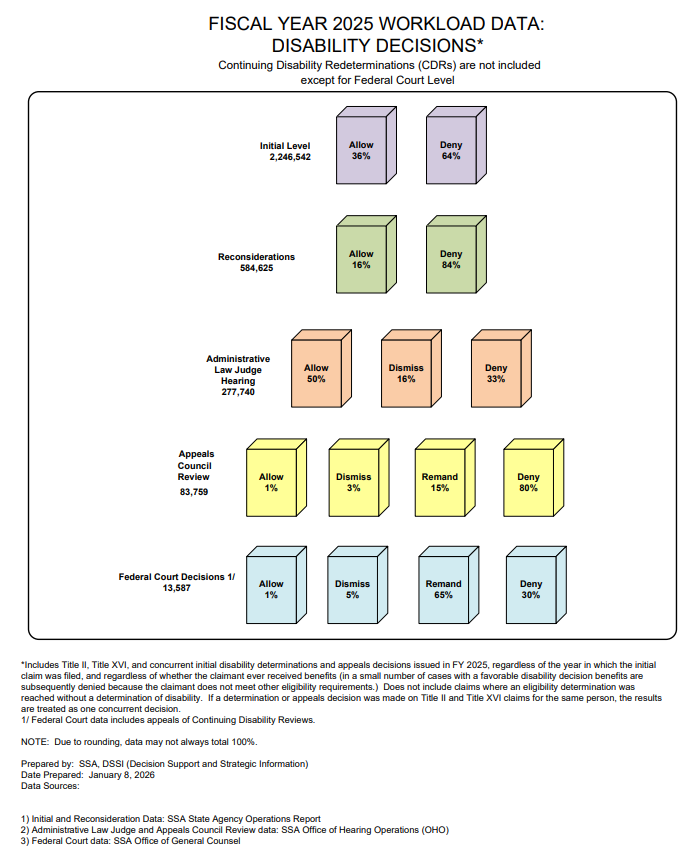 | | | | | | | The Social Security Administration (SSA) has announced an update to its Appointed Representative Services (ARS): representatives can now electronically submit good-cause statements for untimely requests for a hearing directly through ARS at the time the late hearing request is filed. SSA announced this change in an April 15, 2026 “Dear Colleague” letter, characterizing the update as a response to feedback from the representative community and an effort to address good cause issues earlier in the adjudicatory process. According to SSA, ARS now includes “good cause statements for untimely hearing requests” as a selectable option within the existing representative drop down menu. When submitted: SSA states that the change is intended to reduce situations in which cases are scheduled without a threshold good cause determination—or, conversely, linger on hearing dockets despite an unresolved timeliness issue. A claimant generally has 60 days (plus five days for mailing) from receipt of a reconsideration determination to request a hearing before an administrative law judge. When that deadline is missed, SSA may still accept the request only if good cause is established under the regulations and applicable policy guidance. See 20 C.F.R. §§ 404.911, 416.1411; HALLEX I‑2‑0‑60 (now POMS HA 01205.060). | | | SSA must consider circumstances beyond the claimant’s control that may have prevented timely filing. Examples include serious illness or hospitalization; physical, mental, educational, or linguistic limitations; or misleading or confusing SSA notices or actions. In practice, late hearing requests commonly arise in cases involving housing instability, health crises, mental illness, language access barriers, or notice problems —circumstances frequently present for low-income claimants and unrepresented individuals. Advocates may also encounter late filings when representation begins after the deadline has passed and counsel must reconstruct events supporting good cause. While this systems change does not alter the substantive good cause standard or shift the burden of proof, it is an improvement that could reduce unnecessary dismissals or delays. | | | | | | | | | | In a February 17, 2026 Dear Colleague letter, the Social Security Administration (SSA) announced a significant modernization effort by joining the Trusted Exchange Framework and Common Agreement (TEFCA), a nationwide health data-sharing network designed to streamline the exchange of electronic medical records. By connecting through eHealth Exchange as its Qualified Health Information Network (QHIN), SSA aims to dramatically improve how it obtains medical evidence for disability claims. Historically, disability adjudication has relied heavily on manual processes, including faxed or mailed medical records, often causing significant delays and lost records. TEFCA replaces this system with standardized, secure, near–real-time electronic data exchange between SSA and healthcare providers nationwide. Early reports by SSA suggest that this interoperability could reduce claim processing times by more than 50 percent in many cases. The shift also reflects SSA’s broader move toward a “digital-first” adjudication model as stated by Jay Ortis, Chief of Disability Adjudication at SSA. Initial implementation is already underway, with some health systems beginning to transmit records directly to SSA through the network, signaling the start of a nationwide transition. SSA’s involvement has now distinguished TEFCA as the universal onramp for interoperability. For advocates, SSA’s entry into TEFCA represents a potentially transformative development. Faster access to medical evidence could reduce delays in disability determinations, particularly in cases where obtaining records has historically been a bottleneck. At the same time, the change underscores the importance of ensuring that medical providers are connected to interoperable networks and that claimant records are complete and accessible. | | | | | | | |  | | | | | The Social Security Administration (SSA) issued an Emergency Message (EM) on March 16, 2026, addressing expedited handling of priority disability cases. EM-26011 responds in part to a 2024 Inspector General audit that found gaps in consistency, monitoring, and the absence of clear processing timeframes for priority claims, which contributed to delays for thousands of claimants. A more recent March 2026 Inspector General audit also raised concerns related critical payment processing, finding that SSA incorrectly processed nearly 40 percent of “critical” and other emergency payments, resulting in both overpayments and underpayments. The EM has two purposes: (1) to establish new timeframes for certain priority case types that previously lacked specific deadlines, and (2) to remind staff of existing, unchanged timeframes for other priority categories. EM-26011 reinforces that certain categories of claims—such as presumptive disability/blindness, unhoused claimants, delayed cases, inquiries from public officials, and fast-track cases like Quick Disability Determinations (QDD) and Compassionate Allowances (CAL)—must be identified early and handled on an expedited basis. The agency emphasizes that staff across field offices, Disability Determination Services (DDS), and hearing levels must follow specific internal timeframes for early case actions, including prompt assignment and initiation of development, while continuing to monitor cases throughout processing. Although later stages of development may depend on factors outside SSA control (such as obtaining medical evidence), the policy stresses that proactive follow-up and internal tracking are essential to prevent unnecessary delays. Importantly, the message does not create an entirely new system but clarifies expectations and introduces new internal timelines and follow-up procedures for newly receipted cases, while reminding staff to continue =applying existing priority-case policies. Under SSA’s Program Operations Manual System (POMS), “priority cases” (often called critical or expedited cases) are categories of disability claims that must be handled faster than the normal queue—but the key point is that the current POMS generally requires expedited handling without setting rigid, universal deadlines. See POMS DI 23020.001 and 23022.000. The EM signals that further updates for timeframes to the POMS are forthcoming, but offers the following guidelines until that time: Presumptive Disability or Blindness (PD/PB) The field office (FO) must add the PD/PB flag in the EDCS system before transferring the case to DDS. - FO/work support unit (WSU): Schedule appointment within 3 workdays of claimant contact or 800-number referral.
- FO/WSU: Enter disability information and transfer to DDS within 2 workdays (certified electronic folders) or 7 workdays (non-certified).
- DDS: Receipt case within 2 workdays (7 for non-certified) and assign to an adjudicator by the next workday.
Delayed Cases A case is considered delayed when it has been at a workstation for more than 70 calendar days — measured against normal processing experience. The Aged Case flag does not apply at the Hearing or Appeals Council level. - FO/WSU: Flag the case for expedited processing and transfer within 2–3 workdays after receipt of all necessary information.
- DDS: Assign within 2–3 workdays of receipt — whether it is an initial case, reconsideration, CDR, or a case returned by Central Operations or Risk and Quality that has been at the FO for 70+ days.
| | | Homeless Cases A claimant is homeless if they lack a fixed, regular, and adequate nighttime residence, or expect to lose current accommodations within 14 days with no fixed residence to follow. The FO/WSU flags the claim as Homeless whenever a claimant alleges or case information indicates homelessness. DDS may also add the flag in DCPS or eView systems. - FO/WSU: Complete all required forms during the initial interview without curtailment. Transfer no later than the next workday.
- DDS: Assign no later than the next workday after receipt.
QDD and CAL Cases - FO/WSU: Complete all required development, including a full application and all non-medical factors.
- FO/WSU: If a deferred application was taken and the case is later identified as QDD or CAL, re-contact the claimant within 1 workday to complete a full application and non-medical development.
- FO/WSU: When notified that a case has been manually added for CAL processing, add a 20-day tickle date to the MCS DW01 or CCE Development Worksheet and initiate full non-medical development.
- DDS: Assign and initiate development within 1 workday of receipt.
Inquiries from Public Officials Important distinction: for public official inquiries, priority means a timely response to the official — not expediting the underlying disability case unless it independently qualifies (e.g., CAL, QDD, Terminal Illness (TERI), dire need). - FO/WSU (Congressional and Non-Congressional): Reply within 20 workdays. If unresolved, send an interim reply and set a 30-day diary for follow-up until case processing is complete.
- DDS (Congressional): Respond within 7 calendar days. Final reply due within 20 calendar days of acknowledgement; if not possible, send interim reply with subsequent communication every 30 calendar days.
- DDS (Non-Congressional): Respond within 14 calendar days. Same interim/final reply framework as Congressional inquiries.
- DDS (White House referrals): Substantive or final reply within 9 working days.
Timeframes are unchanged for TERI, Military Casualty/Wounded Warrior (MC/WW) and VAPT, and dire need. For advocates, EM-26011 highlights the ongoing importance of identifying priority case criteria early—such as dire need, terminal illness, or unhoused— and ensuring those flags are clearly documented and tracked. While EM-26011's timeframes apply to cases receipted on or after March 16, 2026, for cases already in the pipeline, advocates should push for compliance as a matter of policy spirit, even if the specific deadlines technically apply to new receipts. The policy underscores that expedited processing is not discretionary; it is a structured requirement designed to reduce the financial and medical hardship caused by delays in disability adjudication. | | | | | | | | | | The Social Security Administration (SSA) has issued Social Security Ruling (SSR) 26-1p, a new ruling that clarifies how adjudicators evaluate continuing disability reviews (CDRs) for children receiving Supplemental Security Income (SSI) benefits. This is timely considering the push by the agency to fund more CDRs in 2026. While the ruling does not change the underlying legal standard, it represents an effort to simplify and standardize how the Medical Improvement Review Standard (MIRS) is applied in these cases. At its core, SSR 26-1p streamlines the three-step evaluation process used in childhood CDRs. The ruling confirms that adjudicators must determine: (1) whether there has been medical improvement in the impairments identified at the comparison point decision (CPD); (2) whether those impairments still meet or medically equal the listing considered at the time of the CPD; and (3) whether the child’s current impairments—considered as a whole—meet, medically equal, or functionally equal the listings. Importantly, the ruling eliminates prior redundancies in the analysis, particularly by removing the requirement to evaluate “functional equivalence” at multiple steps in the process. SSR 26-1p also formally rescinds earlier guidance (SSR 05-3p), which had become outdated due to changes in the regulatory framework and the passage of time. The agency explained that older instructions, particularly those tied to pre-2001 comparison point decisions, are no longer relevant, allowing SSA to consolidate and simplify its subregulatory guidance. | | | For advocates, the practical impact of SSR 26-1p is twofold. First, it reinforces that medical improvement remains the central question in any childhood CDR, and that adjudicators must clearly compare prior and current evidence. Second, by simplifying the evaluation structure, the ruling may reduce analytical errors, but it also places greater emphasis on clear articulation at each step, particularly when SSA finds that disability has ceased. Although limited to childhood SSI cases, SSR 26-1p reflects a broader trend within SSA toward streamlining adjudication and standardizing decision-making in post-entitlement reviews. This also potentially overlaps with trends to make changes to how the CDRs are being performed, which is also discussed in a different article in this quarter’s Disability Law News. Advocates should be prepared to use the ruling both as a guide to the proper sequence of analysis and as a tool for challenging decisions that fail to follow the clarified MIRS framework. | | | | | | | | | | The Office of Personnel Management (OPM) has finalized a sweeping new rule reshaping key aspects of the federal civil service, signaling a significant shift in how certain government employees are classified, protected, and removed. Published on February 6, 2026, the rule—titled “Improving Performance, Accountability, and Responsiveness in the Civil Service”—creates a new category of federal workers known as “Schedule Policy/Career” (Schedule P/C) positions. This final rule implements Executive Order 14171, which directed OPM to modernize how policy-influencing positions are designated and managed across the federal government to ensure that employees holding these crucially important positions can be held accountable for poor performance or misconduct. Notably, OPM received more than 40,500 public comments on the proposal and acknowledged that roughly 94% opposed it. While these positions remain part of the career civil service and must be filled through merit-based processes, they are now treated as at-will employment, meaning they are exempt from traditional civil service protections, including adverse action procedures and appeals. The rule also makes clear that Schedule Policy/Career may not be used for workforce reshaping or mass layoffs or to circumvent existing reduction-in-force (RIF) laws and procedures. However, proponents of the regulation worry it threatens longstanding merit-based protections, increases political pressure on career staff, weakens collective bargaining, and risks weakening the government’s ability to serve the public. | | | OPM justified the change as a response to longstanding concerns about accountability within the federal workforce. By removing procedural barriers, the rule aims to allow agencies to act more quickly when employees in influential roles fail to meet expectations or resist executive policy direction. OPM has issued implementation guidance and model agency policies (including a template policy protecting Schedule Policy/Career employees against whistleblower retaliation, political discrimination, and other prohibited personnel practices) to support agencies as they adopt the new framework. Critically, the authority to designate positions as Schedule P/C ultimately rests with the President, based on agency recommendations reviewed by OPM. This centralization has raised concerns among critics about potential politicization and reduced job security, while supporters argue it enhances democratic accountability by ensuring that senior career officials are responsive to elected leadership. Democracy Forward is already challenging Schedule P/C in federal district court. For claimant representatives, the takeaway is practical: monitor how the rule is implemented at SSA, track policy changes) and be prepared to respond when policy shifts affect adjudication standards or case development. | | | | | | Send Us Your Decisions!
Have you had a recent ALJ or court decision or SSA update that you would like to see reported in an upcoming issue of the Disability Law News?
We would love to hear from you!
Email Emilia Sicilia or Katherine Courtney with the buttons below! | | | | | | | | | | | |  | | | | | Claimants and advocates are painfully aware of the worsening trends in customer service at the Social Security Administration (SSA). Recently, two new reports have documented how recent administrative changes at SSA over the past year have sharply increased delays, errors, and barriers to human assistance, with particularly severe consequences for the most marginalized claimants. "In the last Year, It's Gotten a Lot Worse" In March 2026, the Disability Rights Education and Defense Fund (DREDF), in partnership with the American Association of People with Disabilities (AAPD), released “In the Last Year, It’s Gotten a Lot Worse”: Barriers to Disability Benefits in 2025. The report is based on interviews conducted in summer 2025 with 52 attorney and non‑attorney disability benefits advocates from 32 organizations nationwide, collectively serving more than 8,000 SSI and SSDI claimants. The authors found that recent SSA administrative changes have produced widespread access barriers, including longer delays in processing and payment, increased errors and seemingly erroneous denials, reduced access to trained human assistance, and the erosion of effective escalation and accountability mechanisms. Advocates consistently described being unable to reach knowledgeable SSA staff or obtain reliable information about case status, even in time‑sensitive or life‑threatening situations. The harms of these changes were not evenly distributed. According to interviewees, people with unstable housing, limited internet access, or cognitive or psychiatric disabilities were disproportionately harmed by SSA’s increased reliance on online portals, automated phone systems, and AI‑driven tools. Advocates reported that clients unable to navigate these systems were more likely to experience benefit interruptions, overpayments without adequate notice, loss of housing or food assistance, and serious health consequences. The report also highlights how these barriers affect advocates themselves. Providers described spending extraordinary amounts of time performing clerical and follow‑up tasks simply to ensure that documents were received, calls returned, or errors corrected—reducing organizational capacity and limiting the number of clients they could competently represent. Several advocates noted that longstanding informal problem‑solving channels within SSA have largely disappeared, leaving few options when routine processes fail. Based on these findings, the report offers ten recommendations. They include staffing the agency to meet service needs; providing meaningful alternatives to online‑only and AI‑driven service models; clearly defining and resourcing escalation pathways; strengthening internal accountability mechanisms; protecting the privacy and benefit access of immigrants and mixed‑status families; and committing to ongoing communication with advocates and beneficiaries before implementing changes that affect customer service or benefit delivery. The DREDF/AAPD report was recently discussed in a webinar hosted by Justice in Aging, Navigating the Social Security Administration: Options for Advocates on April 15, 2026. A panel highlighted strategies for navigating SSA amid diminished responsiveness. | | | One‑Year Report of the Senate Minority’s Social Security War Room A second report was released by the Office of Senator Elizabeth Warren to mark the first anniversary of the Senate minority’s Social Security War Room initiative. The report echoes many of the same operational failures described by legal services providers in the DREDF/AAPD study. The War Room report attributes worsening customer service—including extreme phone wait times, reduced field office accessibility, and delayed claims processing—to significant staffing cuts and internal reassignments at SSA. It characterizes these changes as “back‑door cuts” to Social Security benefits by making lawful access to benefits far more difficult in practice. The report also summarizes congressional oversight efforts that, according to its authors, forced SSA to retreat from or modify certain policies, including proposals that would have limited disability benefit eligibility or obscured service‑level metrics. It underscores ongoing concerns about transparency, data handling, and the cumulative impact of administrative decisions on older adults and people with disabilities. Given SSA’s recent decisions to withhold or narrow the scope of publicly available customer service data, understanding the practical effects of changes at the agency has become more difficult. Against that backdrop, these reports are useful in documenting patterns that are not reliably captured in SSA’s official metrics, particularly where the agency has emphasized selective indicators such as call answer rates over more comprehensive measures of service performance, as reported by Center for Budget and Policy Priorities, news media, and in prior issues of Disability Law News. | | | | | | | | | | This "Bulletin Board" contains information about recent disability decisions from the United States Supreme Court and the United States Court of Appeals for the Second Circuit. The Second Circuit summaries, as well as earlier decisions, are also available here. Synopses of non-precedential summary orders issued by the Second Circuit are available here. We will continue to write more detailed articles about significant decisions as they are issued by these and other Courts, but we hope that these lists will help advocates gain an overview of the body of recent judicial decisions that are important in our judicial circuit. | | | | U.S. v. Vaello Madero, 142 S. Ct. 1539 (April 22, 2022) In an 8-1 decision, the Supreme Court held that the exclusion of residents of Puerto Rico from the Supplemental Security Income (SSI) program does not violate the United States Constitution. The Court applied the rational basis test to find it permissible to treat residents of territories such as Puerto Rico differently than if they lived in a state because of the different tax status applicable to territories, an outcome authorized by the Territories Clause of the Constitution. The Court declined to rebuke the Insular Cases, a line of case law that sanctioned the colonial relationship of the U.S. to the territories, and that determined the full scope of the Constitution did not apply. A lone dissent by Justice Sonia Sotomayor described the majority decision as “especially cruel given those citizens’ dire need for aid.” Carr v. Saul, 141 S.Ct. 1352 (Apr. 22, 2021) The Supreme Court held that a claimant is not precluded from raising a legal issue for the first time in U.S. District Court if it was not raised before the Administrative Law Judge (ALJ). The underlying issue in question in Carr and its companion cases was whether the ALJ was properly appointed under the Appointments Clause of the U.S. Constitution. In the aftermath of Lucia v. Securities and Exchange Commission, 138 S.Ct. 2044 (2018) challenging the constitutionality of SEC ALJs, Carr and other plaintiffs challenged the legitimacy of the ALJs who had denied their disability claims and sought new hearings. The Commissioner argued the plaintiffs had forfeited their Appointments Clause challenges because they had not raised them before SSA during the administrative appeals process. The Supreme Court resolved a conflict in the circuits by holding that given the non-adversarial nature of SSA hearings, issue-exhaustion is not required. Smith v. Berryhill, 139 S.Ct. 1765 (2019) The Supreme Court held that an Appeals Council dismissal of a request for review is a final decision subject to judicial review. The Court unanimously held that where the Appeals Council has dismissed a request for review as untimely after a claimant has obtained a hearing from an ALJ on the merits, the dismissal qualifies as a “final decision . . . made after a hearing” within the meaning of 42 U.S.C § 405(g). It distinguished its earlier ruling in Califano v. Sanders, 430 U.S. 99, 97 S.Ct. 980, 51 L.Ed.2d 192 (1977), by emphasizing that as opposed to the denial of a request for reopening in Sanders, there had been a decision by an ALJ on the merits of the plaintiff’s claim. Biestek v. Berryhill, 139 S.Ct. 1148 (2019) In a 6-3 decision, the Court declined to adopt a categorical rule that a vocational expert’s supporting data must be provided in order for the testimony to constitute substantial evidence. But the majority acknowledged that in some cases it may be possible to draw an adverse inference against a VE who refuses to provide supporting data. | | | | Nunez v. Commissioner of Social Security, 164 F.4th 60 (2d Cir. 2025), (Decided November 25, 2025, but amended on December 29, 2025) The Second Circuit clarified that an ALJ’s residual functional capacity (RFC) assessment must meaningfully reflect a claimant’s documented functional limitations, particularly in areas like concentration, persistence, and attendance. The court held that limiting a claimant to “unskilled, goal-oriented work” is insufficient where the record—including consistent medical opinions and vocational expert testimony—shows moderate limitations in staying on task and maintaining regular attendance. Because the ALJ failed to incorporate or explain the omission of these limitations, despite testimony that such deficits would preclude employment, the court remanded the case for further proceedings. The decision underscores the need to tie medical evidence directly to specific, work-related restrictions and to ensure that RFC findings account for vocationally significant limitations. Flinton v. Commissioner of Social Security, 143 F.4th 90 (2d Cir. July 2, 2025) The Second Circuit vacated the district court’s decision and remanded for a new hearing before a different, properly appointed ALJ. The court held that the plaintiff, whose 2018 hearing was conducted by an ALJ not constitutionally appointed under the Appointments Clause, had not received the remedy required by Lucia v. SEC, 585 U.S. 217 (2018). The Commissioner’s later ratification of that ALJ’s appointment did not cure the defect, as Lucia mandates reassignment to a different ALJ to preserve structural constitutional protections. The court emphasized that such reassignment is not a mere formality but a necessary remedy when a hearing is tainted by an unconstitutional appointment. The decision—referred to as the “Flinton Rule”—requires new hearings before different ALJs in similar cases involving pre-July 2018 appointments. Rubin v. O’Malley, 116 F.4th 145 (2d. Cir. 2024) The Court of Appeals remanded for consideration of the C criteria of Mental Impairment Listing 12.04, finding that the ALJ had failed to provide any rational for why the plaintiff did not meet the criteria. The court also offered what could be helpful language on the limited value of Mental Status Exams (MSEs) that can often derail claims. And it acknowledged that a psychiatrist’s opinion can be based on and supported by the totality of the medical evidence from the whole treatment team, not merely his own limited notes. It rejected, however, the plaintiff’s argument that the ALJ erred in denying the claim without the support of a medical opinion that she could work. But because the ALJ had found the psychiatrist’s opinion and those of the non-examining consultants only partially persuasive and because the claimant had failed to attend a consultative examination, the ALJ’s decision was not supported by substantial evidence. The court remanded for a consultative examination and fuller consideration of the evidence of record. Rucker v. Kijakazi, 48 F.4th 86, 2022 WL 4074410 (2d Cir. Sept. 6, 2022) The court remanded under the pre 2017 opinion evidence regulations that applied to this case, finding the ALJ had not identified substantial evidence to support her conclusion that the plaintiff could work alone except for normal supervision. She also failed to provide good reasons for rejecting the limitations identified by the treating psychiatrist, erroneously rejecting it because it was based on the plaintiff’s own reports. Nor was the plaintiff’s periodic lack of complaints of symptoms sufficient given her lack of insight. The ALJ should not have relied on the plaintiff’s ability to attend therapy as an indication of ability to work. Nor did some positive progress notes and mental status exams justify rejecting the treating source. The ALJ also relied too heavily on a consultative exam. Schillo v. Kijakazi, 31 F.4th 64 (2d Cir. Apr. 6, 2022) The court affirmed the District Court decision under the pre 2017 opinion evidence regulations that applied in this case. It found the ALJ properly accorded lesser weight to the opinions of two treating physicians because one was conclusory and vague and the other, rendered in check-box format, was not supported by the medical evidence. And according to the court, both opinions as to the plaintiff’s tremors and sensory deficits were inconsistent with the medical evidence, which identified only mild tremors, and the plaintiff’s testimony. The court also agreed with the ALJ’s assessment that the opinion of the consultative examiner was entitled to even less weight. It rejected plaintiff’s argument that the ALJ could not make an RFC finding because she had declined to accord controlling weight to any of the medical opinions; the ALJ is entitled to weigh all available evidence to make RFC findings and her conclusion need not perfectly correspond with opinions of record. Finally, the court found that the ALJ’s failure to articulate the so-called Burgess factors for evaluating treating source opinions to be harmless error as it was evident she had applied the substance of the treating physician rule. Fields v. Kijakazi, 24 F.4th 845 (2d Cir. Jan. 28, 2022) The Court of Appeals held that the District Court erred in reducing attorney fees requested by plaintiff’s attorney, Binder & Binder, under 42 U.S.C. § 406(b), as a windfall. The Second Circuit, relying on its decision in Wells v. Sullivan (“Wells II”), 907 F.2d 367, 372 (2d Cir. 1990), and the Supreme Court in Gisbreath v. Barnhart, 535 U.S. 789, 808 (2002), held that to reduce a contingency fee solely on the grounds that the amount requested is a windfall, the court must be clear the fee was not earned by counsel. Here, the appeals court found that the plaintiff’s very experienced attorney represented him professionally, efficiently, and ultimately successfully in four ALJ hearings, several Appeals Council petitions, and two district court appeals. His request for a fee of $40,170, which was 25% of the plaintiff’s retroactive award, was not a windfall even though it constituted an hourly rate of $1,556.98 based on the 25.8 hours expended on representation in the federal court phases of the claims. Colgan v. Kijakazi, 22 F.4th 353 (2d Cir. Jan. 3, 2022) The court remanded, finding the ALJ erred in failing to accord controlling weight to the opinion of the treating physician under the pre 2017 opinion evidence regulations that applied in this case. The court held the ALJ failed to find good reasons under the old regulations for discounting the opinion of a concussion specialist that the plaintiff would be off task 33% of the day and absent more than four days per month due to her headaches and other impairments. The ALJ also erred in discounting the opinion because it was presented in “check box” form; the opinion was supported by voluminous treatment notes. The court criticized the ALJ for “cherry-picking” particular instances of improvement to create inconsistencies with the treating source opinion. And it criticized the ALJ for relying too heavily on the opinions of consulting physicians, particularly where the consulting opinions did not address or dispute the crux of the treating source’s opinion. Alexander v. Saul, 5 F.4th 139 (2d Cir. July 8, 2021), cert. denied, 142 S.Ct. 1461 (Apr. 4, 2022) The Second Circuit upheld a district court’s refusal to extend the time to appeal its decision affirming the Commissioner’s denial of an SSI claim. Although the Circuit was “sympathetic” to the plaintiff, it concluded the district court had not abused its discretion – even though the plaintiff filed her appeal and request for an extension only two days after the 60-day deadline expired. The district court had reasonably applied the “excusable neglect” factors rather “good cause” standard under Fed. R. App. P. 4(a)(5) because the plaintiff’s failure to appeal was at least partially due to her own inadvertence in failing to notify her attorney of her change of address rather than due to her alleged mental illness. The court refused to toll the Rule 4(a)(5) deadline as it is considered jurisdictional and less flexible than the statute of limitations governing the 60-day limit to seek judicial review under 42 U.S.C. § 405(g). Sczepanski v. Saul, 946 F.3d 152 (2d Cir. Jan. 7, 2020) The court held that ability to complete work during the probationary period is relevant to a disability claim. It remanded for further proceedings at Step five of the Sequential Evaluation to determine whether the claimant could perform work as required during the probationary period, including meeting the levels for absenteeism tolerated by the employer. Estrella v. Berryhill, 925 F.3d 90 (2d Cir. 2019) The Second Circuit remanded, finding the ALJ committed procedural error in failing to “explicitly” apply the factors laid out in Burgess v. Astrue, 537 F.3d 117 (2d Cir. 2008), for evaluating treating source opinions. The court reiterated its mandate, rooted both in regulation and precedent, for ALJs to follow specific procedures and adequately explain their reasoning when assigning weight to opinions, citing Selian v. Astrue, 708 F.3d 409, 419-20 (2d Cir. 2013), Halloran v. Barnhart, 362 F.3d 28, 32-33 (2d Cir. 2004)(per curiam). It found the ALJ “cherry picked” the evidence, particularly mental status exam results, without attempting to reconcile longitudinal inconsistencies in this mental health claim. And it criticized the ALJ for relying too heavily on the opinion of the consultative examiner, citing Selian. Lockwood v. Comm’r of SSA, 914 F.3d 87 (2d Cir. 2019) The Court of Appeals remanded because the ALJ had not met his affirmative obligation under SSR 00-4p to inquire about any possible or apparent conflicts between vocational testimony and the Dictionary of Occupational Titles (DOT). The court found the ALJ did not met his burden simply by asking the vocational expert if her testimony was consistent, especially where the ALJ found the plaintiff could not reach overhead, but the three jobs to which the VE testified all required frequent or occasional reaching. Lesterhuis v. Colvin, 805 F.3d 83 (2d Cir. 2015) The Court of Appeals remanded for consideration of a retrospective medical opinion from a treating physician submitted to the Appeals Council, citing Perez v. Chater, 77 F.3d 41, 54 (2d Cir. 1996). The ALJ’s decision was not supported by substantial evidence in light of the new and material medical opinion from the treating physician that the plaintiff would likely miss four days of work per month. Since the vocational expert had testified a claimant who would be absent that frequently would be unable to work, the physician’s opinion, if credited, would suffice to support a determination of disability. The court also faulted the district court for identifying gaps in the treating physician’s knowledge of the plaintiff’s condition. Citing Burgess v. Astrue, 537 F.3d 117, 128 (2d Cir. 2008), the court reiterated it may not “affirm an administrative action on grounds different from those considered by the agency.” Greek v. Colvin, 802 F.3d 370 (2d Cir 2015) The court remanded for clarification of the treating source’s opinion, particularly as to the claimant’s ability to perform postural activities. The doctor had also opined that Mr. Greek would likely be absent from work more than four days a month as a result of his impairments. Since a vocational expert testified there were no jobs Mr. Greek could perform if he had to miss four or more days of work a month, the court found the ALJ’s error misapplication of the factors in the treating physician regulations was not harmless. "After all, SSA's regulations provide a very specific process for evaluating a treating physician's opinion and instruct ALJs to give such opinions 'controlling weight' in all but a limited range of circumstances. See 20 C.F.R. § 404.1527(c)(2); see also Burgess, 537 F.3d at 128." (Emphasis supplied.) McIntyre v. Colvin, 758 F.3d 146 (2d Cir. 2014) The Court of Appeals for the Second Circuit found the ALJ’s failure to incorporate all of the plaintiff’s nonexertional limitations explicitly into the residual functional capacity (RCF) formulation or the hypothetical question posed to the vocational expert (VE) was harmless error. The court ruled that “an ALJ's hypothetical should explicitly incorporate any limitations in concentration, persistence, and pace.” 758 F.3d at 152. But in this case, the evidence demonstrated the plaintiff could engage in simple, routine tasks, low stress tasks despite limits in concentration, persistence, and pace; the hypothetical thus implicitly incorporated those limitations. The court also held that the ALJ’s decision was not internally inconsistent simply because he concluded that the same impairments he had found severe at Step two were not ultimately disabling. Cichocki v. Astrue, 729 F.3d 172 (2d Cir. 2013) The Court held the failure to conduct a function-by-function analysis at Step four of the Sequential Evaluation is not a per se ground for remand. In affirming the decision of the district court, the Court ruled that despite the requirement of Social Security Ruling (SSR) 96-8p, it was joining other circuits in declining to adopt a per se rule that the functions referred to in the SSR must be addressed explicitly. Selian v. Astrue, 708 F.3d 409 (2d Cir. 2013) The Court held the ALJ improperly substituted her own lay opinion by rejecting the claimant’s contention that he has fibromyalgia despite a diagnosis by his treating physician. It found the ALJ misconstrued the treating physician’s treatment notes. It criticized the ALJ for relying too heavily on the findings of a consultative examiner based on a single examination. It also found the ALJ improperly substituted her own criteria for fibromyalgia. Citing the guidance from the American College of Rheumatology now made part of SSR 12-2p, the Court remanded for further proceedings, noting the required finding of tender points was not documented in the records. The Court also held the ALJ’s RFC determination was not supported by substantial evidence. It found the opinion of the consultative examiner upon which the ALJ relied was “remarkably vague.” Finally, the court agreed the ALJ had erred in relying on the Grids to deny the claim. Although it upheld the ALJ’s determination that neither the claimant’s pain nor depression was significant, it concluded the ALJ had not affirmatively determined whether the claimant’s reaching limitations were negligible. | | | | End Note ________________________________________________________________________________________________________ | |  | Systems Fatigue & AI “Brain Fry” | | A recent Harvard Business Review article describes a familiar experience: extended use of generative AI tools can leave some workers feeling mentally fatigued rather than sharpened. Drawing on cognitive science research and interviews with professionals who rely heavily on AI for drafting and analysis, researchers found that outsourcing small acts of thinking—summarizing, phrasing, deciding what comes next—can produce what the authors refer to as “AI brain fry,” defined as “mental fatigue from excessive use or oversight of AI tools beyond one’s cognitive capacity.” They distinguished this trend as distinct from burnout. Workers interviewed for the study likened brain fry to “brain fog”, a hangover, sometimes resulting in headaches. They correlated it to extensive task-switching and information overload. Those in legal roles reported the lowest levels of AI brain fry (6%), and those in marketing reported the highest (26%). Their findings showed that AI could improve burnout if used to replace routine or repetitive tasks. But when the AI tools require a worker’s direct monitoring or oversight, there is a greater degree of mental fatigue or AI brain fry. There is also increase when the AI tools increase the workload. The authors frame their findings as “both a guide and a warning.” They recommend that to avoid “AI brain fry” and capture sustainable value, leaders should redesign jobs, workflows, and tools with clear limits on oversight, set explicit expectations around AI, measure impact rather than intensity of AI use, build worker skills like problem framing and prioritization, and treat human attention as a finite resource by monitoring cognitive load and safeguarding against mental fatigue. | | | | | | Disability Law News© Disability Law News©
is published four times per year by:
Empire Justice Center
1 West Main Street, Suite 200
Rochester, NY 14614
Phone: (585) 454-4060
The newsletter is written and edited by:
Emilia Sicilia, Esq.
Katherine Courtney, Esq.
Ann Biddle, Esq.
April 2026 issue.
Copyright© 2026,
Empire Justice Center
All rights reserved.
Articles may be reprinted
only with permission
of the authors. Available online at: www.empirejustice.org | | | | | | | | | |